A question many parents face after a diagnosis, and the answer the autism community keeps giving.
Imagine you’re the parent of a 2-year-old who was just diagnosed with Level 3 autism. Your son understands almost everything you say, but he can’t yet get the words out. He points, makes sounds, and looks up at you, hoping you’ll supply the word he’s reaching for.
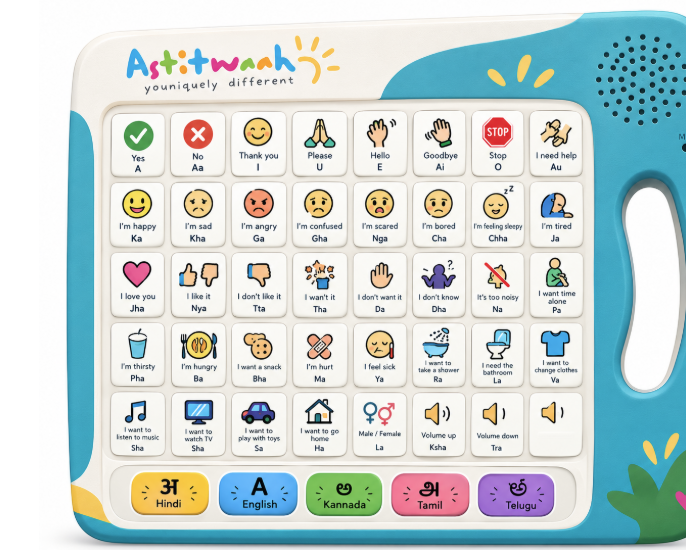
His therapy team, which includes speech, OT, PT, and developmental intervention, suggests an AAC (Augmentative and Alternative Communication) device. But you hesitate. What if he relies on it too much? What if it stops him from learning to talk?
A parent recently asked this exact question in an online autism parenting community. The responses, from parents who have been through it, were remarkably consistent.
The Short Answer: Start Early
Nearly everyone who replied said the same thing: introduce the AAC device as soon as you can. Many were parents of autistic children with very similar early experiences, and several mentioned that research backs this up.
What Parents Said
AAC supports speech instead of blocking it
The biggest fear is that a device will become a substitute for talking. Parents and professionals in the thread said the opposite is more often true. When a child presses a button and hears the word spoken aloud, they get a clear model to imitate. That repetition helps build the connections the brain needs, and many children begin making vocalizations and word approximations along the way.
It reduces frustration for everyone
As non-verbal children grow, not being able to say what they want can become overwhelming. Several parents described how much frustration and difficult behavior eased once their child had a reliable way to communicate. Needs were met faster, meltdowns became less frequent, and everyone in the house felt calmer.
It teaches the power of communication
Before a child can learn words, they need to learn that communicating works. Pressing a button and getting what they want is a lot more effective than crying or screaming. One parent shared that their child eventually realized spoken words were a quicker shortcut than the device, and began to speak on his own.
It takes the pressure off
Speaking is hard. One commenter explained it well: you have to choose the word, control your breath, and coordinate your mouth and tongue. For many autistic children, those physical demands are a real barrier. AAC removes them, so the child can focus on the part that matters, which is communicating.
Success Stories
- A parent of a Level 3, non-verbal child shared that their son is now 12 and very talkative. They credit the AAC device with bridging the gap when he was little.
- Another parent, whose son is now 21, called AAC the single thing that improved his life the most. It let him spell, read, and communicate safely and effectively.
- Several initially hesitant parents found that their children used the device to repeat things and build connections, which led to vocal approximations and eventually spoken words.
A Cautionary Perspective
Not every story was a triumph, and one was a quiet reminder. A parent shared that they chose not to introduce AAC early on. Years later, their son is still non-verbal and now struggles to learn a device. The takeaway wasn’t blame. It was that the early years are a valuable window, and waiting has a cost.
The Bottom Line
The community’s message was clear: AAC isn’t a crutch that replaces speech. It’s a stepping stone. It gives a child a voice now, lowers frustration, and often clears the path for spoken language to follow. And if speech doesn’t come, the child still has a way to express themselves, which matters just as much.
If you’re in this situation, talk with your child’s speech-language pathologist about which device or system fits your child, and how to model its use at home. Hearing from other families can be reassuring, but your care team knows your child best.
Have you used AAC with your child, or are you thinking about it? Share your experience in the comments. Your story might be exactly what another parent needs to read.
This post is based on a discussion among parents in an online community and is for general information only. It isn’t medical advice.